
Plough’s “Bread & Wine: Readings for Lent & Easter” – Review by Bradley Jersak
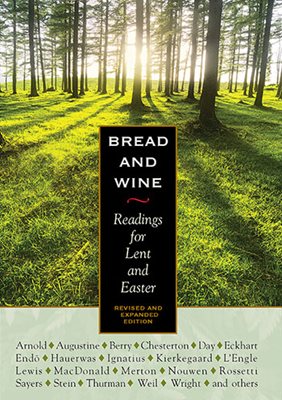 Plough Publishing, “Bread & Wine: Readings for Lent & Easter”
Review by Bradley Jersak
Plough Publishing, “Bread & Wine: Readings for Lent & Easter”
Review by Bradley Jersak
Plough Publishing has once again offered a high-quality treasure-trove from Christianity’s classical authors. Bread & Wine: Readings for Lent & Easter is a beautiful hardcover (with sleeve) expanded edition of daily devotional readings for Lent and Easter. This anthology of 96 daily readings (about 2-1/2 pages or ~600 words each) gathers together riches from across the centuries–from the early church fathers to medieval mystics to modern saints, and a number of living authors. It features scholars, mystics, activists and literary giants from the Greek East to the Latin West and represents both Catholic and Protestant voices. While Plough has plumbed the spiritual depths of the tradition, each selection is bite-sized and accessible as a nourishing taste of daily bread, This expanded edition has added many voices and warrants its place as a keeper for annual use well beyond the bounds of the Lenten season and Pentecost.
Each section also includes an opening, soul-stirring poem (worthy of memorization).
The seven sections are:
- Invitation
- Temptation
- Passion
- Crucifixion
- Resurrection
- New Life
- Pentecost
Christmas Is What God Does – Fr. Kenneth Tanner
Icon by by Ivanka Demchuk UBP The story of the world—the story we just heard read in the church as our gospel for Christmas, the world’s true story from which all true stories are told—happened in a world exactly like our world.It was as is ours a world of...
We Should Be Unimpressed – Christmas Eve Sermon by Allen Doerksen
Isaiah 9:2-7; Luke 2:1-20 Recounting his visit to Bethlehem Fr. Allen unpacks what he saw that day in light of Isaiah's majestic prophecy and the familiar scene painted by Luke. Audio version HERE ISAIAH 9:2-7 The people who walked in...
Ernest Hemmingway: Ski Nomad – Ron Dart
There were no ski lifts from Schruns and no funiculars. You climbed on foot carrying your skis and higher up, where the snow was too deep, you climbed on seal skins that you attached to the bottoms of the skis . At the tops of the mountain valleys there were the big...
Mountain Mentors – Poem by Ron Dart
Mountain Mentors Delores LaChapelle (d. January 22 2007) Edward LaChapelle (d. February 1 2007) I was young...
Alan Dennis’ “Snow Nomad: An Avalanche Memoir” – Review by Ron Dart
Alan Dennis, Snow Nomad: An Avalanche Memoir Friesen Press, 2022 Review by Ron Dart I have had an ongoing interest, the last few decades, in the life and philosophic vision of Dolores LaChapelle. LaChapelle’s early pioneering work with Arne Naess in deep...
Mary and John: Troubled Families – Ron Dart
House of the Virgin Mary When Jesus saw his mother there, and the disciple whom he loved standing nearby, he said to his mother, “Dear woman, here is your son,” and to the disciple, “Here is your mother.” From that time on, this disciple took her into his home (John...
Bonhoeffer: Pacifism and Resistance Revisited with help from Karl Barth – Roger Newell
How do we reconcile the fact that the same Dietrich Bonhoeffer whose pacifist sympathies are well known and whose intention to travel to India and visit Gandhi are well documented, joined the Resistance conspiracy to assassinate the German head of state?
The Church is Everywhere (Even In Churches) – Fr. Kenneth Tanner
It is true that the church is universal and so everywhere, enveloping all creation. The church does not have borders or rails or walls.I had a friend whose church was the massive entourage of workers that accompanied the global tours of a rock group. Marriages....
Corporatism, Commonweal, and Just Society – Lazar Puhalo
INTENT AND CONCEPT Since we are going to be discussing corporatism and commonweal in various contexts, we should say something about these two concepts. Corporatism is a basic principle of fascism. It seeks to curtail individualism, not in the...