
Munther Isaac: Palestinian Christian Pastor on War, Hope, and Love – with Lee C. Camp
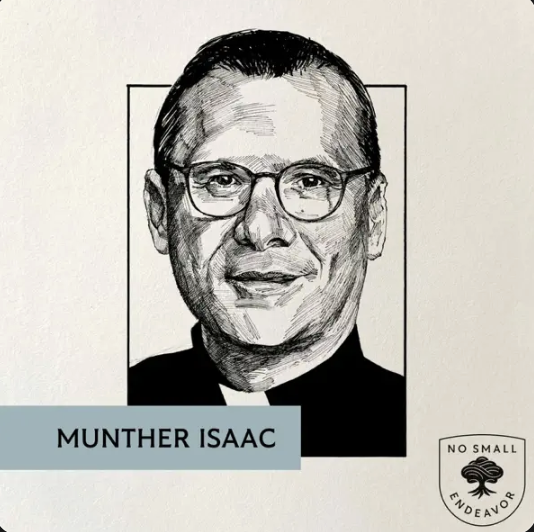 Imagine you’re in charge of pastoring a congregation amidst a war. What does it mean to love your enemies when violence is outside your window, and visceral images of your congregation’s devastation fill your phone? How would you find hope and carry on?
CLICK HERE TO LISTEN
Palestinian Lutheran pastor Munther Isaac joins Lee C. Camp from his home in the West Bank to discuss his book Christ in the Rubble: Faith, the Bible, and the Genocide in Gaza. Drawing from his experience shepherding congregations through two years of war, Munther reflects on grief, anger, and the moral danger of becoming numb to suffering, while still insisting on nonviolence, justice, and the stubborn call to love of enemy. This conversation wrestles with the collision of politics and theology, the misuse of religious language, and what authentic human flourishing, meaning, and courage can look like in the midst of rubble. Key Ideas:- Christ also asked where God was amidst suffering. Munther insists that, in Gaza’s devastation, God is not distant but present “under the rubble,” with the oppressed, displaced, and grieving.
- Nonviolence and creative resistance are needed to break cycles of violence. What it means for a Palestinian pastor to reject terrorism and militarism, yet still speak of “creative resistance in the logic of love” as a practice of justice, courage, and meaningful living.
- Language can be used to warp our imagination. How labels like “terrorism” and “self-defense” can distort moral vision, and why Munther believes reclaiming moral language is essential to the common good and the search for meaning and purpose.
- To stop loving is to lose our humanity. Munther’s insistence that true happiness and well-being require refusing to dehumanize even one’s enemies, guarding the heart from numbness, and insisting that we are created to love one another.
- Religious imagination has real-world implications. Theological worldviews often shape policy, war, and public imagination. Munthers asks, what might it mean for theology and culture to serve justice, mercy, and flourishing instead?
Contemplation: Theoria & Theosis, Epiphany & Theophany – Lazar Puhalo
Einstein relates that when he was trying to think of a way to formulate relativity while hiking alone in the mountains. He had an “epiphany” about how to formulate it. When Archimedes lept naked from the bathtub and ran shouting “Eureka,” he had experienced an epiphany. Christian theoria leads, not to an epiphany, but to theophany. Saint Gregory calls us to Christian theoria – a new contemplation of “being.” And Saint Maximos would agree: we have “received” only when we have “contemplated.”
Hello world!
Welcome to WordPress. This is your first post. Edit or delete it, then start writing!
Q&R: What is Satan? Who tempted Jesus? Brian Zahnd & Bradley Jersak
Question: How are we to understand “Satan” or “the satan”? Brian Zahnd: I don’t know that we fully can, but I understand the satan to be a cosmic spiritual-psychic phenomenon arising from idolatry and accusation, reaching its ultimate form in anti-human empire. Thus,...
Wake Up. Jonah: A Midrash – Eric H. Janzen
Wake Up. Jonah Jonah sat down, cleaned the dust from his sleeves, and leaned on his staff. His discoloured skin showed prominently now in the sunlight. How many days was it since he had so unceremoniously been delivered onto the sands of the...
Why Reject the Ontology of Demons? Eric H. Janzen (response by Wm. Paul Young)
Why Reject the Ontology of Demons? 1. Spiritual Integrity—By rejecting demon ontology, we stop using them as scapegoats to avoid our responsibility as humans for our sin and evil actions. 2. Spiritual Freedom—By rejecting demon ontology, we stop believing in evil,...
Carl Truman: Sic et Non – Ron Dart
Carl R. Trueman, The Rise and Triumph of the Modern Self: Cultural Amnesia, Expressive Individualism, and the Road to Sexual Revolution (Crossway, Wheaton: 2020).Carl R. Trueman, Strange New World: How Thinkers and Activists Redefined Identity and Sparked the Sexual...
“The Devil… from the Arché” – Bradley Jersak
Brooke Quist, a new friend of mine through Open Table Conference, blew my mind. He was asking for my thoughts on who or what Satan (the satan) or the devil is. After sharing a few of the thoughts I’ve gleaned from René Girard, Michael Hardin, Brian Zahnd, and...
Review of Beckett and Ellsberg’s “Dearest Sister Wendy” – by Ron Dart
Review of Sister Wendy Beckett and Robert Ellsberg, Dearest Sister Wendy: A Surprising Story of Faith and Friendship (Orbis Books, 2022). Review by Ron Dart. I have, sitting on my desk before me, Sister Wendy Beckett’s classic visual and textual beauty and must-read...
“BY WATER: The Felix Manz Story” – A Graphic Novel – Review by Bradley Jersak
"In a city astir with dangerous new ideas, the son of a Catholic priest becomes a leader of a nonviolent revolution." –back cover Five hundred years ago, Europe was set ablaze by the violence and wars of the Catholic-Protestant schism, where priests...
The Road to Theocratic Authoritarianism – Lazar Puhalo
We are in a transitional stage in which much of the popular certainty of the postwar era is slowly fading. In such an era, and when politics is no longer an elitist enterprise but a more populist one, the politician who can rouse the passions of the crowd will gain a...