
Sylvie Weil’s “The Wanderings of Isaac André Gedalia” Review by B. Jersak
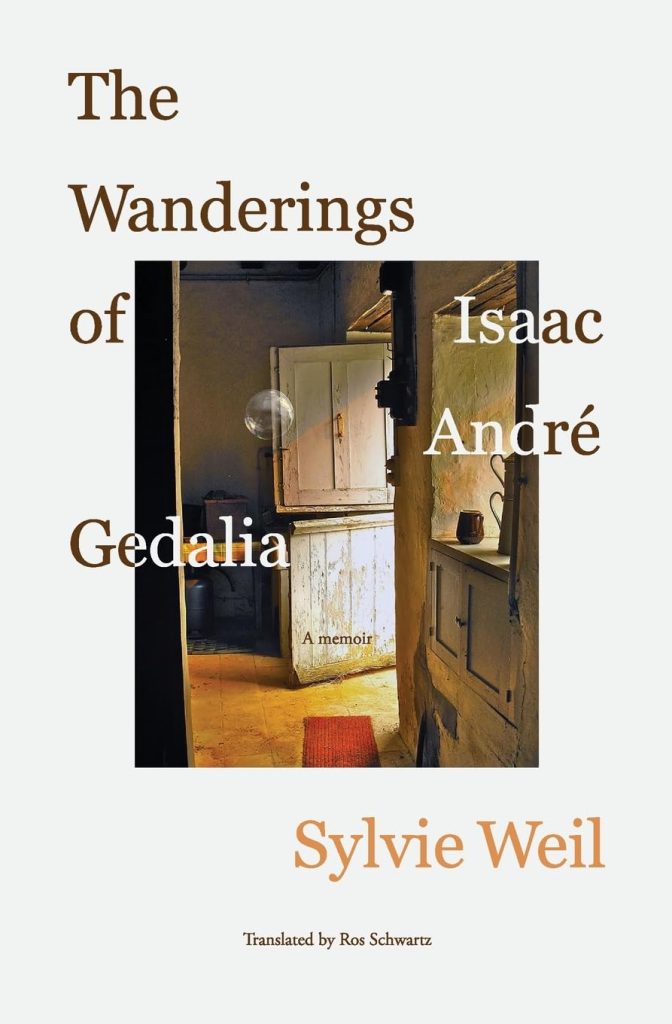 Sylvie Weil’s The Wanderings of Isaac André Gedalia (IPBooks, 2025)
Review by Bradley Jersak
SUMMARY — In The Wanderings of Isaac André Gedalia, Sylvie Weil invites us into the curious pilgrimage of a pre-born soul who ventures from the warmth of his mother’s womb, through a murderous miscarriage, traveling from Brooklyn to Japan to Paris, and finally home—familiar and eternal. Little Isaac drifts across boundaries of time, memory, and longing—half exile, half guide—gathering stories, recalling genealogies, and recounting legends along the way. With whimsy and a deep ache, this charming tale lingers where loss and love refuse to part.
PART I — PERSONAL CORRESPONDENCE
Dear Sylvie,
Because of your accessible writing style and the brevity of your book on wee Isaac, I had imagined reading it in one or two sittings. But for this tender heart and curious mind, that is just not possible. Instead, I’ve decided to slow way down to read it more contemplatively and studiously… and especially devotionally. With the most attente I can manage. Four to six pages each night as the last thing I do with my eyes, and I will read it twice through.
Parts of this story are beautifully whimsical, then turn to heartbreaking sadness (all the more so because I imagine I’m hearing something of your grief?). And then suddenly, you drop in the rabbinical teaching on Gan Eden and Senoy, Sansenoi, and Semangalof. Now I’m off scouring the Talmud!
My goodness. I love your heart and mind.
Arrested,
Bradley
MY BACKSTORY WITH SYLVIE WEIL
Before completing my review below, I’d like to indulge in the backstory of who I know Sylvie Weil to be.
I first read about Sylvie Weil while researching her aunt Simone Weil for my dissertation, eventually published as From the Cave to the Cross: the Cruciform Theology of George P. Grant and Simone Weil (St Macrina Press, 2015).
From July 6 to November 10, 1942 Simone Weil passed through New York en route to London, when Sylvie was born in September. Simone, utterly smitten with her niece, wrote to her parents (July 12, 1943), just over six weeks before her death,
Sylvie Weil’s The Wanderings of Isaac André Gedalia (IPBooks, 2025)
Review by Bradley Jersak
SUMMARY — In The Wanderings of Isaac André Gedalia, Sylvie Weil invites us into the curious pilgrimage of a pre-born soul who ventures from the warmth of his mother’s womb, through a murderous miscarriage, traveling from Brooklyn to Japan to Paris, and finally home—familiar and eternal. Little Isaac drifts across boundaries of time, memory, and longing—half exile, half guide—gathering stories, recalling genealogies, and recounting legends along the way. With whimsy and a deep ache, this charming tale lingers where loss and love refuse to part.
PART I — PERSONAL CORRESPONDENCE
Dear Sylvie,
Because of your accessible writing style and the brevity of your book on wee Isaac, I had imagined reading it in one or two sittings. But for this tender heart and curious mind, that is just not possible. Instead, I’ve decided to slow way down to read it more contemplatively and studiously… and especially devotionally. With the most attente I can manage. Four to six pages each night as the last thing I do with my eyes, and I will read it twice through.
Parts of this story are beautifully whimsical, then turn to heartbreaking sadness (all the more so because I imagine I’m hearing something of your grief?). And then suddenly, you drop in the rabbinical teaching on Gan Eden and Senoy, Sansenoi, and Semangalof. Now I’m off scouring the Talmud!
My goodness. I love your heart and mind.
Arrested,
Bradley
MY BACKSTORY WITH SYLVIE WEIL
Before completing my review below, I’d like to indulge in the backstory of who I know Sylvie Weil to be.
I first read about Sylvie Weil while researching her aunt Simone Weil for my dissertation, eventually published as From the Cave to the Cross: the Cruciform Theology of George P. Grant and Simone Weil (St Macrina Press, 2015).
From July 6 to November 10, 1942 Simone Weil passed through New York en route to London, when Sylvie was born in September. Simone, utterly smitten with her niece, wrote to her parents (July 12, 1943), just over six weeks before her death,
“Je pense tout le temps a Sylvie et a son rire ensoleillé.” “I think constantly of Sylvie and her sunny laughter.” (Simone Weil, Écrits de Londres et dernières lettres, 227).That sparked a desire in me to engage Sylvie directly, read about her experience in Simone’s shadow, but more, who Sylvie is in her own right. Then began our correspondence in early 2011, through a delightful phone conversation and email exchange.
 She confided at the time that despite their physical resemblance, she felt like more of a blend of her aunt and Brigitte Bardot. I playfully suggested a biopic titled “Finding Sylvie,” starring Audrey Tautou… I even created a mock movie poster, which allowed me to hear Sylvie’s “sunny laughter.” (That’s Sylvie, center-left, back in the day).
During that time, I found her memoir, At Home with Andre and Simone Weil—a beautiful window into Sylvie’s heart, mind, and literary genius. I wrote a review of the book for the Clarion Journal HERE, which also featured an interview with my gracious new heroine.
As part of my PhD studies, I was also hard at work on a fresh translation of Simone Weil’s Attente de Dieu and Lettre à un Religieux, which I gathered into one volume, Awaiting God. The highlight of that work was an Introduction that Sylvie kindly contributed, titled “Simone Weil and the Rabbis: Compassion and Tsedekah.” That essay puts Simone Weil’s relationship with Jewish thought into perspective. Sylvie includes source material from the Rabbis that demonstrates Weil’s alignment (however reluctantly) with rabbinical thought.
VENICE SAVED
She confided at the time that despite their physical resemblance, she felt like more of a blend of her aunt and Brigitte Bardot. I playfully suggested a biopic titled “Finding Sylvie,” starring Audrey Tautou… I even created a mock movie poster, which allowed me to hear Sylvie’s “sunny laughter.” (That’s Sylvie, center-left, back in the day).
During that time, I found her memoir, At Home with Andre and Simone Weil—a beautiful window into Sylvie’s heart, mind, and literary genius. I wrote a review of the book for the Clarion Journal HERE, which also featured an interview with my gracious new heroine.
As part of my PhD studies, I was also hard at work on a fresh translation of Simone Weil’s Attente de Dieu and Lettre à un Religieux, which I gathered into one volume, Awaiting God. The highlight of that work was an Introduction that Sylvie kindly contributed, titled “Simone Weil and the Rabbis: Compassion and Tsedekah.” That essay puts Simone Weil’s relationship with Jewish thought into perspective. Sylvie includes source material from the Rabbis that demonstrates Weil’s alignment (however reluctantly) with rabbinical thought.
VENICE SAVED
Version 1.0.0
For Sylvie Weil, with gratitude While Simone Weil’s sustained intensity can be exhausting, your youthful heart soars, reminding us to breathe.All of that to say, Sylvie revealed that she had published a new novella last year— The Wanderings of Isaac André Gedalia to which I now return: REVIEW PART II: THE WANDERINGS—FICTION… ONLY SORT OF My message to her at the outset of this review says almost everything I need to say about the book, but I make some references that warrant more detail. A Beautiful Whimsy — I mention the beautiful whimsy of Wanderings because Weil captivates us with little Isaac’s voice of child-soul wisdom and curiosity. He holds all the brilliance of a soul trained in Gan Eden, who “sees from one end of the universe to the other… sees the whole world” with the heart of a child willing to explore with abandon. Fetal Isaac’s observations of the world—of local culture, human motivation, and quirky characters were enthralling. How Sylvie inhabited his consciousness, I don’t know. But I can say that somehow, she lent me those all-seeing child-eyes to behold in detail what she described—and the fathomless knowledge her (our) little soul would forget at birth with the finger tap of an angel just above his top lip. I briefly felt the buoyancy of that preborn mind and knew that to see my world as he did, I would be revisiting Isaac’s angelic tutelage repeatedly. Heartbreaking Sadness — The growing grief I referenced earlier came as it dawned on me that I was not simply reading unmoored imaginative fiction. Writers are told to write what they know. The locations in this world that Sylvie described are (or were) actual places—intersections and boulevards and canals that I could (and did) explore on street-view in Google Maps. The fascinating family and intimate aspects of their lives and their intriguing history are Sylvie’s actual ancestry—the story of Gedalia who evaded the pogroms, heirlooms from her Jewish grandparents, interactions with her dad—and her own life. I slowly came to believe that Sylvie was opening her heart to how she processed the miscarriage of her own unborn child over the course of thirty-four years. This came out strongly in the chapters narrated by Isaac’s ‘mother-to-be.’ Isaac says, “My mother was filled with a crushing silence. A horrified silence. Which lasted a long time. Days and days. Perhaps weeks. Years.” And when he laments, “… I haven’t moved on … it’s even the main event of my life … and I’ve never really got over it…,” I wondered about how a mother might internalize a miscarried soul as part of herself. If this isn’t Sylvie’s own lamentation… I’ve never seen fiction so true. Rabbinical Teaching — While I held the tension of whimsy and grief of a dead child’s tale, the book would also pull me aside into Jewish rabbis, texts, and traditions I’d never previously studied. When my heart was full and needed to ruminate, Sylvie offered enjoyable excursions into Midrash around Adam and Eve, then Abraham, Sarah, and Isaac. I learned of the demon offspring of Lilith and Samael—of the mazzikim—and the angel guardians Senoy, Sansenoi and Semangalof. I read about ancient rabbis, like Joshua ben Levi (“Treatise on Gan Eden”) and Solomon of Troyes (Rashi). And don’t get me started on the chapters in Japan that describe the Buddhist mythologies of the Sanzu River demons and Jizo Bosatsu, the Bodhisattva guardian of deceased children. My goodness—a wild detour I’d not expected! In all these texts, (alongside Elie Wiesel’s Messengers of God), Sylvie reveals the playfulness of Jewish hermeneutics that had been lost to Western Christianity via modernity. I enjoyed the complete absence of factualism (the need to prove) or literalism (quests to assign one fixed meaning). What we have are profoundly sacred stories that weave themselves into our story—precisely as Sylvie Weil has done in Isaac’s wanderings. The last thing I want to share is how important it is to know people for who they are. I suppose after my first call with Sylvie so many years ago, I felt excited to have encountered Simone Weil’s niece. Today, I’m happier to encounter Sylvie Weil (sans Simone, who needs no reference in this book). Simone is too small a box for Sylvie, who is a kaleidoscope of her “harlequin heritage.” I’m only beginning to meditate on whether or how to understand why this little soul crossed the border to visit my heart-house so deeply. But I’ve had a fleeting glimpse: through this book, it has been my privilege to sit at Sylvie’s feet—the rabbi who shows me, “There is such a thing as a bonheurs tristes—a sad happiness.” Merci!
Beyond Fight-Mode Entrenchment with St Teresa — Chuck DeGroat
There was another one of those predictable dustups this week, I heard, where someone from a particular tribe of Christianity was grumpy that women had become too empowered and that Christianity had become too empathic. You know, the kind of piece that only further...
A Pseudo-Psalm, by a Pseudo-Jonah: Jessica Boudreaux
A Pseudo-Psalm, by a Pseudo-Jonah:Jessica Boudreaux Destroy them Lord -And then destroy me, tooFor i have also done evilBefore Your ever-searching eyesAnd am no longer worthyTo be called Your childBut unlike Nineveh that Great City,I kick and fight and...
Lament is Not Enough: Evangelicals offer “Thoughts and Prayers” for Gaza – Bruce Fisk
“I've seen the flame of hope among the hopelessAnd that was truly the biggest heartbreak of all.” Bruce Cockburn, Last Night of the World (1999) Permission: Omar Esstar October 7, 2023: a dark day that changed everything. Ever since, a nation of traumatized,...
Steve Bell – Refugee (on the Slaughter of Innocents)
Lyrics (from the Keening for the Bell album) We think of him as safe beneath the steepleOr cozy in a crib beside the fontBut he is with a million displaced peopleOn the long road of weariness and wantFor even as we sing our final carolThe hounded child is up and on...
The Slaughter of the Innocents: Then and Now – Ron Dart
We should, rightly so, meditate on the slaughter of the innocents at the birth of Christ. But, we are living through a much greater and more brutal slaughter of the innocents at the present time – such crude and vindictive brutality makes the Roman killing of innocent children pale in comparison – then was tragic, now raises the meaning of barbarism to a new level.
Christmas Homily: Jesus’ Birth in Extra-Biblical Sources — Sarah Pickering
This Christmas, I am not going to retell the same old story we tell every year. I am not going to tell the whole Mary and Joseph, donkey ride to Bethlehem, inn keeper, shepherds, sheep etc. It is a good story, but this year, we are telling another. The stories of...
How Still We See Thee Lie? Bethlehem Then and Now – Bradley Jersak
The stubborn fact is that the birth of Christ did not end hostility the David’s birthplace or across our world to this day. Even the traditional site of Christ’s birth has seen waves of repeated violence since Herod’s famous crime against humanity. If Jesus was indeed the promised Prince of Peace, where is the peace?
Peri Zahnd’s Top 5 Books of 2023
My five favorite books of 2023, ranked chronologically as I read them: one fiction, two memoirs, one theology, and one historical fiction: Demon Copperhead by Barbara Kingsolver, a 2023 Pulitzer Prize winner. It is as good as her classic from 25 years ago, The...
The Impure Spirit? Jared Robinson
The impure spirit? When Jesus showed up on the scene, people were trying to decipher if he was the Messiah they were expecting. The question of how he was going to redeem was also on the table. Imagine being at church …WITH the one you came to learn about. But then a...
Values Centered Practice – Ron Loewen
Values Centered PracticeRon Loewenhttps://loewencoaching.com/ When I began my work with Mennonite Central Committee Canada as Restorative Justice Coordinator, I was doing so as a Mennonite Christian. I come from a long line of Mennonites; it is a faith, an ethnicity,...