
Liza J. Rankow’s “Soul Medicine for a Fractured World” – Review by Felicia Murrell
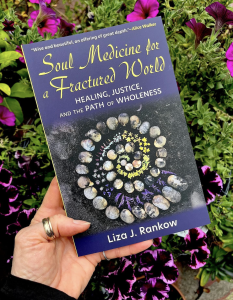 Soul Medicine for a Fractured World: Healing, Justice, and the Path of Wholeness
by Dr. Liza J. Rankow
Maryknoll, NY: Orbis Books, 2026
225 pages, USD$26.00
Reviewed by Felicia Murrell
In an era defined by profound global disorientation, Dr. Liza J. Rankow’s Soul Medicine for a Fractured World: Healing, Justice, and the Path of Wholeness emerges as a vital salve and a revolutionary call to action. This text is more than a book; it is a profound exploration of how we might guide ourselves through the enormous atrocities of our time by grounding our work in the context of eternality and the cosmos.
At the core of our vocation is the practice of presence, and Rankow’s work serves as a true masterclass in deep listening. She defines this not merely as an auditory skill, but as a holistic practice of listening with our whole being to open ourselves to Spirit. Rankow’s insights provide a robust framework for helping us sit with the sediment that lies in the recesses of our individual and collective soul. She reframes this disruption not as a cruelty, but as a grace—a divine invitation to alignment.
One of the most valuable contributions of this manuscript is its ability to shift the seeker’s perspective from the overwhelmed little me to a self situated within a larger, sacred body. Rankow reminds us that we are part of an unbroken chain rooted in Love, encompassing ancestors, future generations, and all of nature. This expansive inclusivity is essential for navigating crisis and upheaval. Her work invites us to move beyond the paralyzing chaos of the present moment and find strength in the Infinite.
Central to this shift is a fundamental inquiry that strikes at the heart of the contemplative life: What is it to know ourselves as part of one another and kin to all life? How does that knowing shift your own ideas about responsibility and the life we are building together—a life where all belong and all contribute to one another from a place of deep care and intentionality?
Focusing on the intersection of spirituality and social justice, Rankow provides a clear pathway. She challenges us to move toward “a whole-souled commitment” to be “aligned within ourselves, at our innermost core and with all that we are”—a state of embodied integrity that honors the sacred wholeness of Life. This book encourages a “disciplined soul force” (120) where love becomes more than a reactive emotion; it becomes the engine for social responsibility. Rankow asks: “Where are we contributing to the very conditions we deplore—violence, poverty, injustice, environmental destruction (117)?”
Inviting us to confront difficult truths, even within ourselves, Rankow empowers us to become active agents of transformation and repair, helping to “hospice the dying world, while simultaneously midwifing the emerging one (6).”
Soul Medicine for a Fractured World is an essential companion for anyone seeking to connect more deeply and find strength beyond the noise of the modern world. Dr. Rankow offers a wisdom that invites us to move beyond the need for certainty and instead live comfortably in mystery. Whether used for personal enrichment or as a foundational text in training programs, this work is a profound reminder that we are resourced by the Infinite to respond to our historical moment with transformative love.
Felicia Murrell is a spiritual director and the author of AND: The Restorative Power of Love In An Either/Or World, with over 20 years of church leadership experience and certifications as a Master Life Coach and Enneagram Practitioner. For more about Felicia, visit her website: www.feliciamurrell.com
Soul Medicine for a Fractured World: Healing, Justice, and the Path of Wholeness
by Dr. Liza J. Rankow
Maryknoll, NY: Orbis Books, 2026
225 pages, USD$26.00
Reviewed by Felicia Murrell
In an era defined by profound global disorientation, Dr. Liza J. Rankow’s Soul Medicine for a Fractured World: Healing, Justice, and the Path of Wholeness emerges as a vital salve and a revolutionary call to action. This text is more than a book; it is a profound exploration of how we might guide ourselves through the enormous atrocities of our time by grounding our work in the context of eternality and the cosmos.
At the core of our vocation is the practice of presence, and Rankow’s work serves as a true masterclass in deep listening. She defines this not merely as an auditory skill, but as a holistic practice of listening with our whole being to open ourselves to Spirit. Rankow’s insights provide a robust framework for helping us sit with the sediment that lies in the recesses of our individual and collective soul. She reframes this disruption not as a cruelty, but as a grace—a divine invitation to alignment.
One of the most valuable contributions of this manuscript is its ability to shift the seeker’s perspective from the overwhelmed little me to a self situated within a larger, sacred body. Rankow reminds us that we are part of an unbroken chain rooted in Love, encompassing ancestors, future generations, and all of nature. This expansive inclusivity is essential for navigating crisis and upheaval. Her work invites us to move beyond the paralyzing chaos of the present moment and find strength in the Infinite.
Central to this shift is a fundamental inquiry that strikes at the heart of the contemplative life: What is it to know ourselves as part of one another and kin to all life? How does that knowing shift your own ideas about responsibility and the life we are building together—a life where all belong and all contribute to one another from a place of deep care and intentionality?
Focusing on the intersection of spirituality and social justice, Rankow provides a clear pathway. She challenges us to move toward “a whole-souled commitment” to be “aligned within ourselves, at our innermost core and with all that we are”—a state of embodied integrity that honors the sacred wholeness of Life. This book encourages a “disciplined soul force” (120) where love becomes more than a reactive emotion; it becomes the engine for social responsibility. Rankow asks: “Where are we contributing to the very conditions we deplore—violence, poverty, injustice, environmental destruction (117)?”
Inviting us to confront difficult truths, even within ourselves, Rankow empowers us to become active agents of transformation and repair, helping to “hospice the dying world, while simultaneously midwifing the emerging one (6).”
Soul Medicine for a Fractured World is an essential companion for anyone seeking to connect more deeply and find strength beyond the noise of the modern world. Dr. Rankow offers a wisdom that invites us to move beyond the need for certainty and instead live comfortably in mystery. Whether used for personal enrichment or as a foundational text in training programs, this work is a profound reminder that we are resourced by the Infinite to respond to our historical moment with transformative love.
Felicia Murrell is a spiritual director and the author of AND: The Restorative Power of Love In An Either/Or World, with over 20 years of church leadership experience and certifications as a Master Life Coach and Enneagram Practitioner. For more about Felicia, visit her website: www.feliciamurrell.com The Mystic & the Lawyer – the Nature of Redemption – Lazar Puhalo
The Orthodox concept of redemption may be briefly epitomized as follows: the meaning of "atonement" is really "to remove (or overcome) the cause of separation." In other words, man is alienated from God by sin (by his constant "missing of the...
The World’s True Story Told Well – Kenneth Tanner
Icon: Copyright Oleksandr Antoniuk - UPB to KT When we tell the story of the world well, it is converting, not condemning. The world’s true story gives life.And we cannot tell the world’s story well—we cannot tell our story well—if we do not tell God’s story...
Deconstructing Deconstruction – Felicia Murrell (w/ Bradley Jersak)
Deconstructing Deconstruction – Felicia Murrell (w/Brad Jersak) Editor’s Note: The following interview is a partial transcript of one for four forthcoming podcast interviews on “deconstruction” at Stephen Backhouse’s Tent Theology Podcast. Bradley Jersak will be...
Ron Dart – Myth and Meaning and the Inklings
Ron Dart – Scrutinizing Scruton: Canadian High Toryism & Scrutonia
CLICK HERE to purchase your copy
“Out of the Embers: Faith after the Great Deconstruction” – Ron Dart interview with Bradley Jersak
Grounding: My Operational Realities – Ken Hood
Ken Hood OPERATIONAL REALITIES We all live by, and within, our own realities. Most of the time, we all share these realities. We all act as if the chair we sit in is real, and will hold us. We believe, and in this case, it’s “true” based on empirical...
“I can only get to Alyosha via Ivan”: Confessions of a Grumpy Universalist – Adrian Lovegrove w/ Bradley Jersak
The following was a conversation via email between Adrian Lovegrove and Bradley Jersak over the final weeks of 2022. ADRIAN LOVEGROVE I began formal theological study back in 2011. I could no longer buy the evangelical package deal, but I hoped there...
Christmas Begins in the Quiet – C.E.W. Green
Ecce Homo by CEW Green Christmas Begins in the QuietLk. 2:1-14 * Thursday, Christmas Eve eve, as Julie and the kids and I drove down to my parents’ house, I found myself thinking about the Holy Family. (I have been doing a lot of that over the last few months and...
C.S. Lewis, Atonement & Universal Salvation – Bradley Jersak
UNIVERSAL SALVATION While I am convinced of the NT promise of ultimate redemption, I continue to be reluctant to identify myself personally with the label 'universalism.' That is mainly because its opponents typically assume they know what that word means, and...